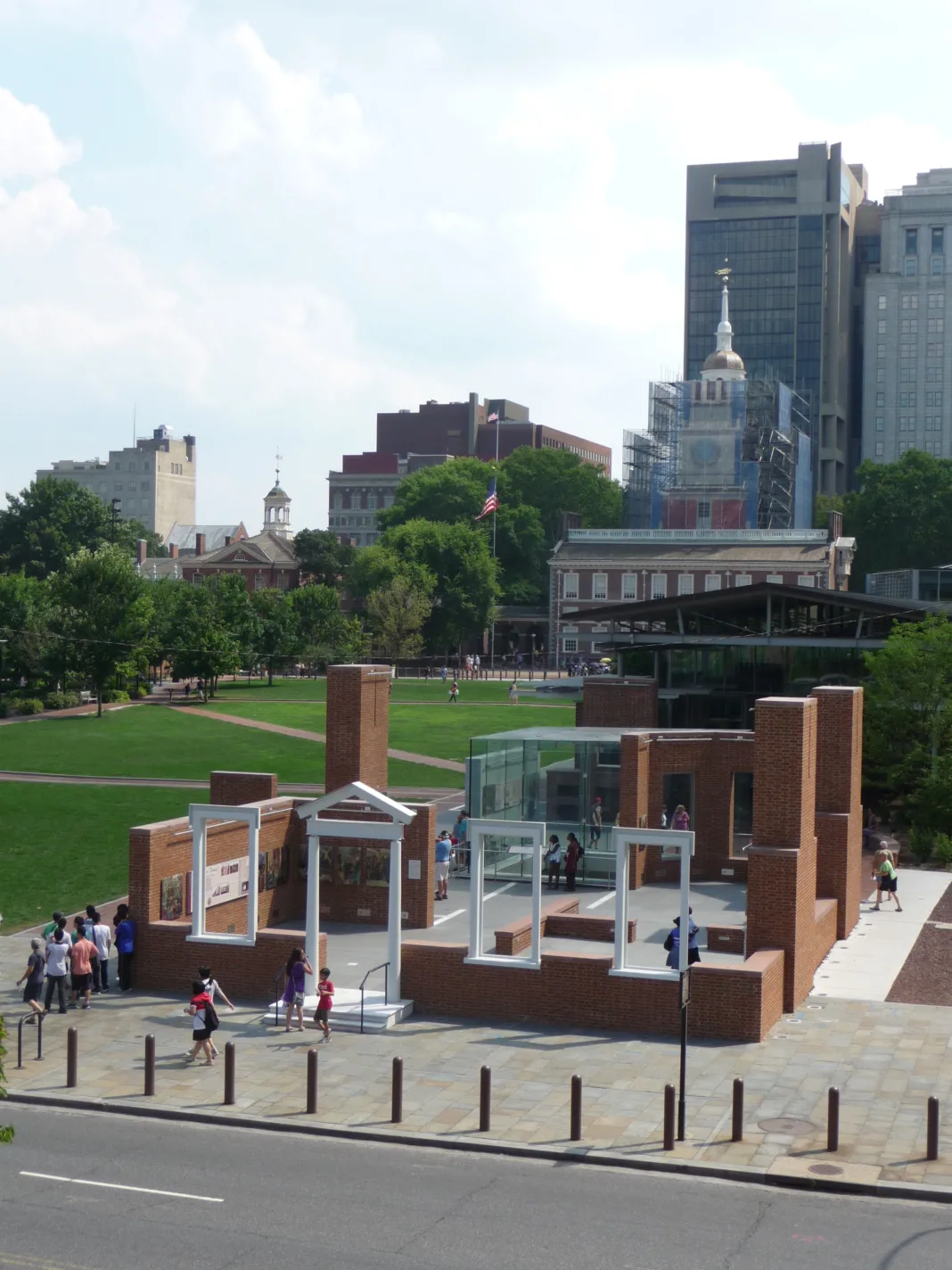


Two Philadelphia organizations sued the Trump administration November 23 to seek restoration of the original slavery exhibit at the President’s House Site, where George Washington held nine people in bondage. The federal complaint alleges racial discrimination and unlawful agency action in the removal and replacement of the memorial’s interpretive materials.
What happened
The Avenging the Ancestors Coalition and The Black Journey sued Interior Secretary Doug Burgum, acting Park Service Director Jessica Bowron and their agencies in Pennsylvania federal court.
The groups ask the court to order the memorial returned to its original condition, including repairs, and to set aside directives permitting the removal of educational panels and disabling of five motion-activated monitors. They also seek preliminary and permanent injunctions against enforcement of the challenged orders.
The President’s House stood at Sixth and Market streets on Independence Mall. The Park Service’s current visitor page describes the site as the home used by Presidents Washington and John Adams before the federal government moved to Washington, D.C. The original building was demolished in the nineteenth century; foundations discovered by archaeologists in 2007 remain visible.
That page identifies the nine enslaved people who lived and worked in Washington’s Philadelphia household at different times between 1790 and 1797: Austin, Christopher Sheels, Giles, Hercules, Joe Richardson, Moll, Ona Judge, Paris and Richmond. It describes Hercules’ work as a chef and his escape in 1797, and Ona Judge’s escape in 1796.
The current official interpretation also says Washington rotated enslaved people into and out of Pennsylvania because state law provided freedom after six months of residence. Alongside that history, it emphasizes his evolving views on slavery and the provisions of his will. The lawsuit disputes the balance and omissions of the replacement exhibit, rather than establishing that the Park Service now makes no reference to slavery.
The broader federal policy comes from Trump’s March 27, 2025 executive order, titled “Restoring Truth and Sanity to American History.” It directs Interior to review changes to monuments and similar properties since January 2020 and to reinstate earlier versions where appropriate and consistent with law.
The order also directs officials to remove material they consider to inappropriately disparage historical Americans and to emphasize national achievements and progress. Its general provisions require implementation consistent with applicable law. The new suit challenges how that policy was applied at this site.
An earlier lawsuit brought by Philadelphia challenged the federal government’s changes. A federal appeals court subsequently allowed the replacement work to proceed, Reuters reported. WHYY explained that the new plaintiffs are advancing a distinct constitutional argument about racial discrimination, rather than relying only on the city’s earlier dispute over management of the exhibit.
How outlets covered it
Reuters emphasized the groups’ claim of selective removal of Black history and placed the case within Trump’s wider effort to reshape federal historical interpretation.
WHYY focused on what differentiates this lawsuit from the city’s earlier challenge, explaining the equal-protection theory and the plaintiffs’ relationship with the memorial.
Associated Press contrasted the plaintiffs’ criticism with Interior’s defense of the replacement panels. It reported the department’s earlier position that the new exhibit acknowledges slavery’s injustices and tells the stories of Washington’s enslaved household members.
All three accounts described a renewed legal challenge. WHYY concentrated on its legal strategy, while AP gave more space to the department’s prior explanation of the new material.
What’s disputed
The central dispute concerns whether the revised interpretation unlawfully diminishes Black history and reflects discrimination. The Park Service’s published materials retain accounts of enslavement and escape; the plaintiffs argue that the replacement presentation nevertheless omits or softens important realities. The existence of some slavery-related content does not itself settle the legal claims about the changes.
Interior and the Park Service had not immediately responded to the new lawsuit when AP and Reuters reported it. No restoration order in this new case was announced in those reports. The groups’ request for judicial relief now places the legality of the changes before the federal district court.
How this article was produced
This article was generated using AI from the sources linked below. It does not include firsthand reporting or interviews. Our editors monitor published articles and correct errors promptly. Claims attributed to outside sources have not been independently verified by this publication.
Found an error? Email corrections@thecivicbearing.com.
Sources
- Federal court complaint — Avenging the Ancestors Coalition and The Black Journey v. Burgum, No. 2:26-cv-08904 (November 23, 2026)
- Reuters — Trump administration sued over removal of slavery exhibit in Philadelphia (November 23, 2026)
- WHYY — Philadelphia activists launch new legal effort to restore the President’s House slavery exhibit (November 24, 2026)
- Associated Press — Groups sue Trump administration after changes made to Philadelphia slavery exhibit (November 24, 2026)
- National Park Service — Visiting the President’s House Site: From Enslavement to Emancipation (accessed November 24, 2026)
- Executive Order 14253 — Restoring Truth and Sanity to American History (March 27, 2025)