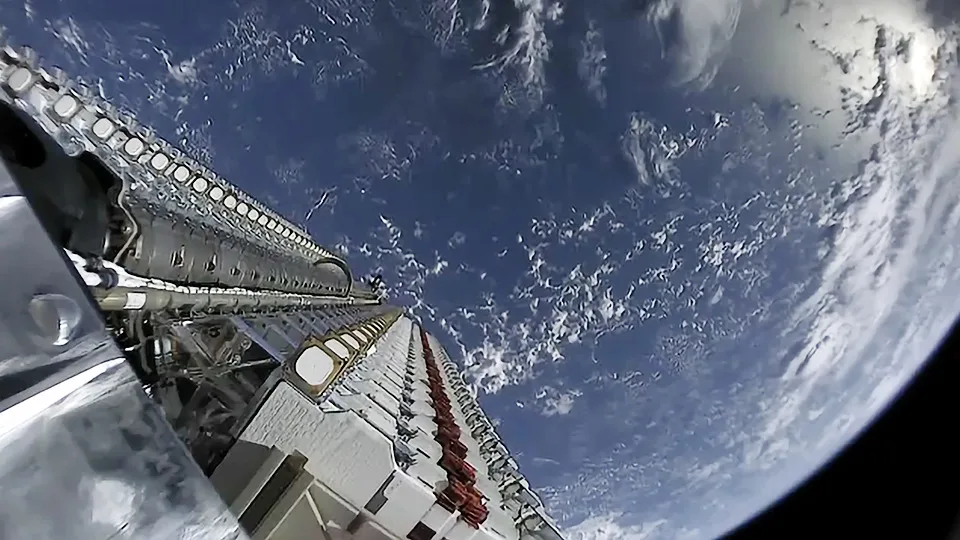



The Federal Communications Commission conditionally authorized SpaceX’s proposed Starmind network of up to 1 million orbital data-center satellites November 25. The order sets deployment milestones through 2040 and leaves additional debris-disposal approvals unresolved for parts of the proposed system.
What happened
The FCC Space Bureau’s order, DA 26-1273, grants the application in part and defers it in part. Its stated scope is backup and emergency radio communications for a constellation intended to operate as data centers in space. Starmind would primarily communicate through optical links, including links with Starlink satellites.
The authorized backup bands are 18.8–19.3 GHz for transmissions toward Earth and 28.6–29.1 GHz for transmissions from Earth. Operations must not cause harmful interference or claim protection from other authorized users. SpaceX must stop the offending operations when documented harmful interference occurs until the problem is resolved.
The proposed orbital shells span altitudes from 500 to 1,002 kilometers. The order requires further action before SpaceX deploys Starmind satellites above 600 kilometers: the company must submit a modification application containing its final orbital-debris mitigation plan addressing the commission’s rules.
A related request to dispose of some retired satellites in other Earth orbits or in orbits around the sun was deferred. The FCC said SpaceX had not supplied enough information to determine whether those alternatives met its requirements. Satellites using a disposal method other than atmospheric reentry would require an additional modification and justification.
The deployment schedule requires one operational satellite by November 25, 2033; 10% of the authorized maximum by November 25, 2035; 50% by November 25, 2038; and completion by November 25, 2040. For a million-satellite authorization, the intermediate milestones correspond to 100,000 and 500,000 satellites.
SpaceX must provide twice-yearly reports covering close approaches, spacecraft removed from operation or screened from deployment, atmospheric reentries, deployed satellites and orbital parameters, and use of the authorized backup radio frequencies. The order also requires coordination with affected federal systems and other spectrum users.
The bureau denied petitions to reject the application from Viasat, Amazon’s Kuiper Systems and the American Astronomical Society. It found that the lower-altitude debris plan complied with its rules while attaching conditions to other aspects of the proposal.
On environmental review, the FCC relied on its October policy regarding space-based operations and declined to require further review under the National Environmental Policy Act. It said rocket-launch environmental effects fall under FAA review and that certain other objections were outside its radio-communications mandate.
The commission also cited SpaceX’s commitment to coordinate with the National Science Foundation on astronomy concerns. It declined to impose additional optical-astronomy conditions, while identifying objections about infrared background, reflectivity and the scale of the constellation in the record.
How outlets covered it
Associated Press foregrounded scientists’ skepticism, including technical and financial obstacles, collision risks and disruption to astronomy. It paired the FCC’s approval with opposition from the American Astronomical Society.
Ars Technica emphasized the long deployment schedule, unresolved disposal permissions and the FCC’s treatment of environmental concerns. It described a regulatory victory that did not establish commercial or technical viability.
Light Reading focused on deployment milestones, network design and continuing reporting obligations, placing the approval within the development of computing infrastructure in orbit.
The outlets agreed that the decision clears a regulatory hurdle. AP stressed scientific objections, Ars examined the latitude and limits of the authorization, and Light Reading developed its operational requirements.
What’s disputed
Whether orbital data centers can work economically at this scale remains unresolved. The FCC declined to substitute its judgment about a business venture’s viability for that of the applicant. That position does not settle the engineering or financing questions.
Astronomers’ concerns also remain contested. The FCC considered SpaceX’s commitments sufficient for its review, while critics described risks to observations and the night sky. Additional debris-plan and disposal decisions are still required under the authorization’s conditions.
Opinion: The Civic Bearing’s Take
This section is opinion and reflects The Civic Bearing’s conservative perspective.
Private enterprise should have room to test ambitious technology without a regulator deciding in advance that a business model cannot succeed. The FCC’s refusal to make that commercial judgment is sensible. Investors and customers should judge whether orbital computing delivers value.
The conditions deserve equally serious attention. Interference protection, credible disposal plans and public reporting should remain enforceable obligations as deployment grows. Approval should allow experimentation while keeping responsibility for operational risks with the company creating them.
How this article was produced
This article was generated using AI from the sources linked below. It does not include firsthand reporting or interviews. Our editors monitor published articles and correct errors promptly. Claims attributed to outside sources have not been independently verified by this publication.
Found an error? Email corrections@thecivicbearing.com.
Sources
- Federal Communications Commission — Starmind memorandum opinion, order and authorization, DA 26-1273 (copy hosted by Light Reading) (November 25, 2026)
- Associated Press — FCC says SpaceX can deploy 1 million satellites for data centers in space. Scientists are skeptical (November 25, 2026)
- Ars Technica — The FCC has authorized SpaceX to deploy 1 million satellites (November 25, 2026)
- Light Reading — SpaceX OK’d to deploy up to 1M AI satellites, complete constellation by 2040 (November 25, 2026)