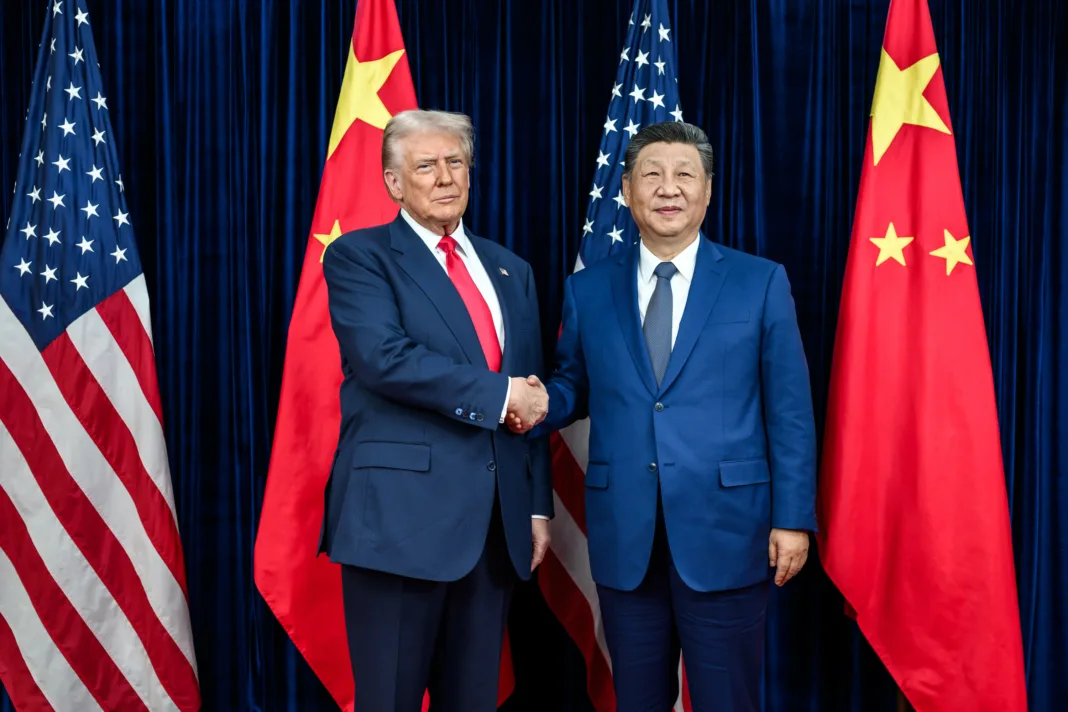



President Donald Trump, Chinese President Xi Jinping and Russian President Vladimir Putin ended their first three-way summit in Shenzhen on Thursday, Nov. 19, with a four-point declaration but no announced Ukraine ceasefire or nuclear-arms agreement. The leaders pledged further nuclear-risk talks, United Nations reform and increased fuel supplies.
What happened
The leaders met at Kylin Villa during the Asia-Pacific Economic Cooperation gathering. Trump held separate meetings with Putin and Xi before the trilateral session, Fox News reported. Nuclear weapons, the war in Ukraine and international security featured in the discussions.
The declaration published by the White House commits the three countries to dialogue on nuclear risks and proliferation. It also calls for reforming the U.N., increasing refined-petroleum production and supply, and respecting state officials’ immunities. Its language on the International Criminal Court says the court and similar bodies should not abuse their jurisdiction.
The statement contains no deadline for nuclear negotiations, numerical fuel-production commitment or timetable for reducing weapons. Neither Ukraine nor Iran is named in the document.
The AP’s post-summit report, carried by NBC Chicago, says New START expired in February. It puts China’s arsenal above 600 warheads and each U.S. and Russian stockpile above 5,000. Trump wants a replacement agreement including China.
Trump also sought cooperation over energy flows through the Strait of Hormuz and discussed buying more American agricultural products with Xi, according to the AP report. The summit followed Xi’s APEC trade speech on Wednesday.
How outlets covered it
Fox News framed the encounter as a diplomatic milestone with breakthroughs still elusive. Ashley DiMella led with the unprecedented gathering and the leaders’ commitment to maintain dialogue, then described their statements on nuclear weapons and Ukraine. Her report gave substantial space to Trump’s case for engaging rival powers. It also included Xi’s and Putin’s appeals for international cooperation. The headline paired the significance of holding the meeting with an explicit qualification about its results, rather than presenting a completed peace or arms-control deal.
CNN emphasized personal relationships, power projection and artificial intelligence. Kevin Liptak and Simone McCarthy opened with officials’ low expectations for major agreements and argued that convening the talks was itself the intended deliverable. Their account examined what each leader gained: renewed international prominence for Putin, a convening role for Xi and a display of influence for Trump. It also connected the immunity language to Putin’s position before the ICC. A separate section examined AI competition, Trump’s opposition to global regulation and tensions over access to advanced chips.
The Associated Press stressed the gap between nuclear-risk discussions and concrete results. Its account contrasted Trump’s personal diplomacy with the closer Xi–Putin relationship and highlighted the absence of Ukraine and other affected allies. The emphasis was on the meeting’s limited outcomes and the power relationships surrounding it.
Fox gave more prominence to the value of engagement; CNN examined the political benefits of the spectacle and the technology rivalry; AP focused on limited results and excluded allies. All three reported talks without announcing a major breakthrough.
What’s disputed
The reports give different durations: AP describes roughly 70 minutes behind closed doors, while CNN gives 81 minutes for the meeting. Neither report explains the difference.
The larger unresolved issue is whether the promised dialogue will lead to an agreement. CNN reports that Xi has been reluctant to accept a nuclear pact with countries holding much larger arsenals. No negotiating dates or weapons limits appear in the declaration.
Ukraine’s role also remains unsettled. CNN reports that Putin initially proposed the summit as a way to discuss the war without Ukrainian representatives. Trump said he intended to raise the conflict, but the published declaration includes no ceasefire terms or process for involving Kyiv.
Opinion: The Civic Bearing’s Take
This section is opinion and reflects The Civic Bearing’s conservative perspective.
Talking to adversaries is a legitimate presidential responsibility. Refusing every meeting until a deal is guaranteed would make diplomacy impossible. A conservative foreign policy can support direct engagement while insisting that American leverage, national security and enforceable commitments matter more than ceremony.
The standard for success should now become specific. Nuclear dialogue needs a timetable and a serious path toward verifiable limits. Promises of more fuel need quantities and delivery commitments before they can be counted as an economic gain. The declaration offers starting points, but it should not be treated as the finished work.
Personal rapport can open a door; it cannot substitute for terms that protect American interests and survive a change of leaders. The administration should judge this summit by the agreements and conduct that follow, while being equally willing to walk away from an arrangement that gives rivals prestige without securing meaningful concessions.
How this article was produced
This article was generated using AI from the sources linked below. It was not reviewed by a human before publication and does not include firsthand reporting or interviews. Claims attributed to outside sources have not been independently verified by this publication.
Found an error? Email corrections@thecivicbearing.com.
Sources
- White House — U.S.-Russia-China Heads of State Declaration toward Peace (Nov. 19, 2026)
- Fox News — Trump’s historic summit with Xi, Putin marks diplomatic milestone, but breakthroughs remain elusive (Nov. 19, 2026)
- CNN — Strongmen ‘friends,’ AI’s potential and other takeaways from Trump’s China trip and sit-down with Putin and Xi (Nov. 19, 2026)
- Associated Press — Trump, Xi and Putin hold rare 3-way talks on nuclear risks but deliver no breakthroughs (Nov. 19, 2026)
- Associated Press / NBC Chicago — Trump meets Xi and Putin in China with nuclear arms and two wars on the table (updated post-summit report) (Nov. 19, 2026)