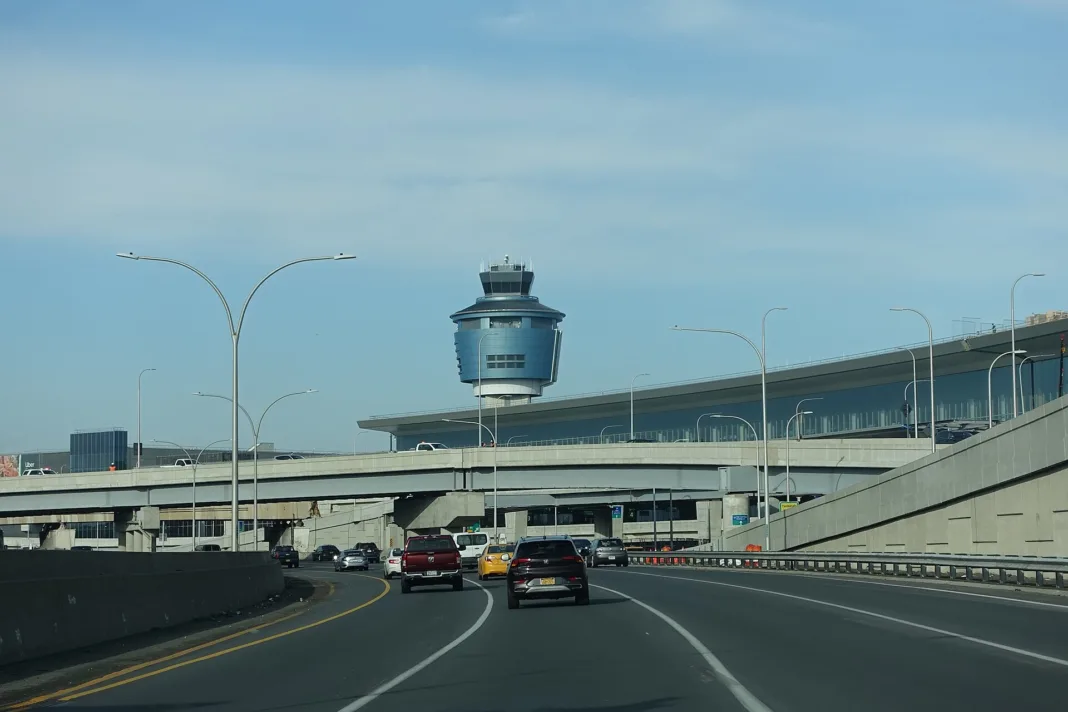


Air traffic controllers at New York’s LaGuardia Airport warned pilots of a possible shoulder-fired missile launcher east of the airfield on Wednesday evening, November 25, briefly holding several departures on one of the busiest travel nights of the year. Port Authority police investigated the report and found it was not credible, and normal operations resumed within about 15 minutes.
What happened
The alert came around 6:30 p.m. Eastern time. “Attention all aircraft, MANPAD alert just east of LaGuardia,” a controller told pilots in a radio call captured by ATC.com and reported by CNN. “Anyone on the frequency advise intentions.”
A MANPADS, or man-portable air-defense system, is a shoulder-fired missile designed to strike low-flying aircraft. When one pilot asked whether the warning referred to “a real MANPAD,” the controller answered that it had come from a report to law enforcement.
According to CNN, the crews of two American Airlines jets, a Delta flight and a Southwest aircraft waiting to depart chose to hold their positions. “I guess we’ll stay put. I don’t want to be the one to test it out,” the Southwest pilot radioed. Arriving flights continued to land, and controllers told crews that anyone uncomfortable had the option to go around.
About 15 minutes after the first call, the tower relayed an update: “We just got an update from the local Port Authority police, and the report seems not credible at this time.” The Port Authority of New York and New Jersey, which operates LaGuardia, said in a statement that the report “was investigated and deemed not to be credible” and that “operations are normal.”
The FAA did not issue a ground stop. Aviation newsletter The Contrail checked the FAA’s national airspace status at 6:54 p.m. and found no ground stop, delay program or closure at LaGuardia, JFK or Newark. The only advisory listed for the three airports was a high-wind warning running through 1 a.m. CNN reported it had asked the FAA for more information.
It was the second such alert at LaGuardia this year. On the night of July 21, controllers issued a MANPADS warning to Delta Flight 2604, arriving from Detroit, telling the crew to use “extreme caution.” The New York Post reported that controllers withdrew the warning within about a minute after Port Authority police judged it a hoax, and the Boeing 737 landed safely. A Port Authority spokesperson told People that an anonymous caller had claimed to be at the end of a runway with a “rocket-propelled grenade” and threatened to shoot down an aircraft. Officers searched the area, found the threat unfounded, and the agency said the incident remained under investigation.
How outlets covered it
The first word came from social media. Accounts that monitor air traffic audio posted the tower’s warning within minutes, often under “BREAKING” labels, and several noted that no ground stop had been ordered. Some described the report as a man spotted in East Elmhurst. Others placed it near Flushing Bay. Within roughly half an hour, many of the same accounts posted that authorities had found the report not credible.
CNN folded the incident into its Thanksgiving travel live coverage. Its account relied on the tower recordings, giving readers the pilots’ exchanges with controllers alongside the Port Authority’s statement. CNN emphasized that departures were briefly delayed and that the report was ultimately not credible.
Times Now led with the all-clear, reporting that flights had resumed after an investigation near Flushing Bay found the threat not credible. It cited a social media news account and recapped the July incident using the New York Post’s reporting.
The Contrail took the most cautious approach in its early reporting. It noted that it had not heard the tower audio or confirmed the alert, and that no official statement had appeared as of 7 p.m. It focused instead on what could be verified: FAA status data showing flights were moving.
Coverage of the July incident struck a sharper tone. The New York Post called it a “harrowing mid-air alert,” while People led with the controller’s “extreme caution” instruction and added the Port Authority’s account of the anonymous caller. Across the outlets reviewed, the core facts agree: the tower issued an alert based on a report to law enforcement, police found it not credible, and no weapon or suspect was reported found.
What’s disputed
Officials have not said who made Wednesday’s report, how it reached police, or whether it resembled July’s anonymous call. No outlet has reported a connection between the two incidents. The FAA had not publicly commented as of Wednesday night.
Accounts also differ on the reported location. Social media posts variously cited East Elmhurst and Flushing Bay, while CNN’s account of the radio call described the report only as “just east of LaGuardia.” Characterizations of the disruption vary too: CNN described several departures as delayed, while FAA data reviewed by The Contrail showed no formal ground stop or delay program. Both can be true, since individual crews chose to wait without the FAA ordering a stoppage.
How this article was produced
This article was generated using AI from the sources linked below. It does not include firsthand reporting or interviews. Our editors monitor published articles and correct errors promptly. Claims attributed to outside sources have not been independently verified by this publication.
Found an error? Email corrections@thecivicbearing.com.
Sources
- CNN — Report of missile launcher at NYC airport delays flights before deemed not credible (November 25, 2026)
- The Contrail — LaGuardia Missile Alert Reports: What We Know and What We Don’t (November 25, 2026)
- Times Now — What Happened At LaGuardia Airport? MANPAD Missile Threat Sparks Concerns, Deemed Non-Credible (November 25, 2026)
- New York Post — Delta pilot spooked with false warning of rocket launcher attack while landing at LaGuardia Airport (July 22, 2026)
- People — Delta Pilot Warned to ‘Use Extreme Caution’ Following False Rocket Launcher Report in N.Y.C. (July 2026)