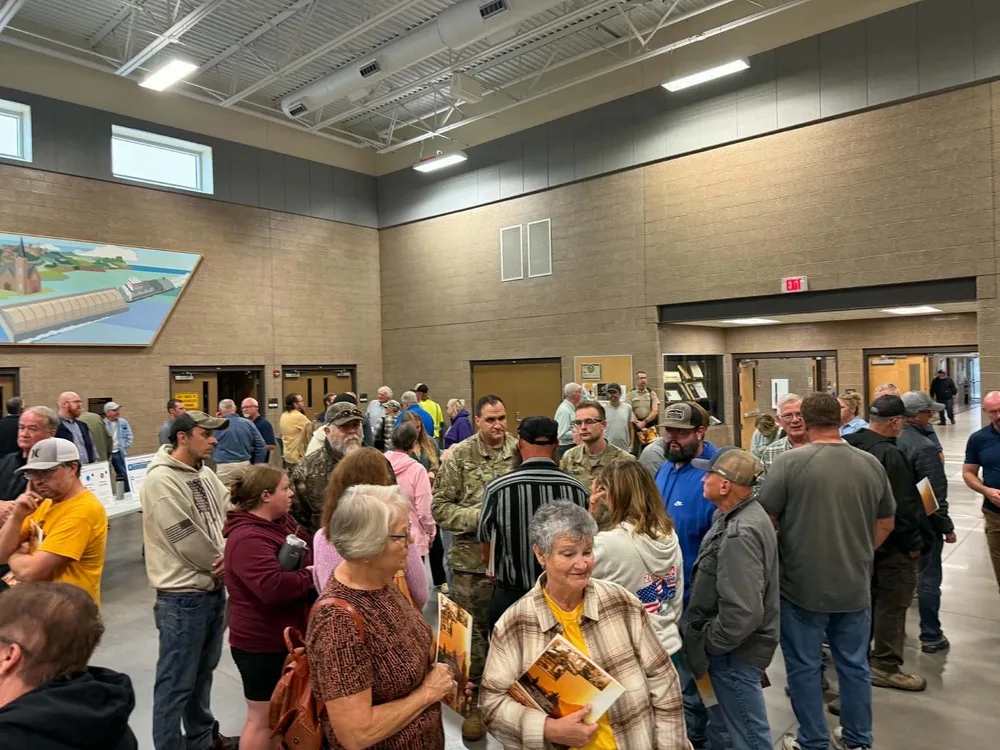


A federal appeals court lifted its hold on the environmental permit for detonating 68 drums of degraded lead azide at the Iowa Army Ammunition Plant on November 23. The Army subsequently confirmed plans to proceed Wednesday morning, November 25, according to Iowa Public Radio, removing a legal obstacle that had stalled the operation near Middletown.
What happened
The Eighth Circuit’s 11-page opinion denied the Iowa Environmental Council and Sierra Club’s emergency request to keep the EPA permit suspended while their challenge continues. The three-judge panel found the groups had not shown they were likely to prevail on their claims or that the other requirements for emergency relief justified a stay.
The decision follows President Donald Trump’s earlier instruction that the operation wait for the court and Gov.-elect Rob Sand’s agreement. Iowa Public Radio reported that acting Army Secretary Adam Telle later described proceeding as a consensus decision and said both Iowa’s current and incoming governors considered it a decision for the experts. Sand’s own statement called on the administration to decide using information from its specialists; it did not directly endorse the detonation.
The court examined the EPA’s emergency permit, rather than issuing a final judgment on every issue in the litigation. It also expressly declined to decide the Army’s separate claim that an emergency munitions exemption would allow action without the permit. The Army is not a defendant in the permit case.
The stockpile had been stored in two earth-covered magazines for more than two decades. The opinion describes how changes in a stabilizing solution allowed the lead azide to recrystallize, increasing its sensitivity to shock and friction. The Army determined in March that the drums had deteriorated and become unstable.
EPA’s November 13 permit authorized detonation in place as well as continued storage. The court said the permit requires containment barriers, weather restrictions, advance public notification, updated air-dispersion modeling and environmental monitoring. It also requires sampling of soil and frequently touched surfaces in affected areas.
Specified sampling must begin within 24 hours after detonation, and the Army must submit a proposed work plan and timetable for necessary remediation, the opinion states. The judges found those conditions showed that EPA had considered potential environmental consequences and imposed measures to address them.
The panel also rejected the groups’ argument that EPA inadequately considered alternatives. It cited evaluation of chemical treatment, closed-chamber thermal treatment, relocation of individual drums and detonation inside the magazines. EPA relied on Army specialists’ conclusion that disturbing the unstable material would create an unacceptable risk of an accidental explosion.
On public notice, the court found that a full 45-day comment period was not a prerequisite to an emergency permit when that delay would be inconsistent with the emergency. It did not decide whether a separate military-function exception also affected notice requirements.
How outlets covered it
Associated Press led with the Army’s Wednesday plan after the court decision. Its report combined the permit ruling with the political dispute over Sand’s role and residents’ preparations.
Iowa Public Radio emphasized the lifted stay and Telle’s subsequent confirmation. It also detailed the competing statements from Trump and Sand and continued demands for public information about the operation.
Both reports describe a court decision followed by an Army plan to proceed. Their shared emphasis is that the legal clearance and the dispute over political responsibility unfolded separately.
What’s disputed
The environmental groups argue that lead-dust risks, protections for vulnerable residents and disposal alternatives have not been adequately addressed. The court acknowledged that controlled detonation poses health and environmental risks but weighed those against the possibility of an uncontrolled explosion.
Its reasoning favored a planned operation with weather limits and mitigation measures over an accidental blast without those protections. Denial of an emergency stay leaves the underlying petition for review unresolved; it does not amount to a finding that the operation carries no risk.
The next operational questions are whether the Army follows the announced Wednesday schedule and how it carries out the permit’s notification, monitoring, sampling and remediation requirements. The ruling removes the court’s temporary hold on the permit while those obligations remain in place.
How this article was produced
This article was generated using AI from the sources linked below. It does not include firsthand reporting or interviews. Our editors monitor published articles and correct errors promptly. Claims attributed to outside sources have not been independently verified by this publication.
Found an error? Email corrections@thecivicbearing.com.
Sources
- Eighth Circuit Court of Appeals — Iowa Environmental Council v. EPA, No. 26-3374 (November 23, 2026)
- Associated Press — US Army to detonate degraded bomb-making material in Iowa after getting court approval (November 23, 2026)
- Iowa Public Radio — Court lifts administrative stay, Army confirms detonation will move forward Wednesday (accessed November 24, 2026)